

Hybrid employee retention is the strategy of keeping top talent engaged and committed across in-office and remote work environments through intentional culture building and recognition initiatives. As flexible work has become more important to employees and job seekers around the world, companies are developing creative strategies to connect with their hybrid and remote employees using modern technology. A strong employee engagement strategy gives workers the flexibility they want in their schedules while promoting retention.
However, offering flexibility isn’t enough to guarantee loyalty. The real challenge lies in keeping remote and in-office workers equally connected and valued within your company. Because every employee has different preferences and needs, a one-size-fits-all approach to engagement often falls short in a hybrid setting. In this guide, we’ll explore the retention challenges of the modern workplace. Then, we’ll share six hybrid employee retention strategies your company can implement today.
Here’s what we’ll cover:
- Hybrid Work FAQs
- How to Create a Hybrid Employee Retention Plan
- 6 Hybrid Employee Retention Strategies
Key takeaways
- Flexible schedules attract top talent, but keeping hybrid workers engaged takes deliberate strategies to reduce proximity bias, prevent isolation, and keep off-site workers aligned with your company’s culture and long-term vision.
- A successful retention plan starts with auditing your current hybrid landscape and setting clear communication norms that protect your team’s focus time and work-life balance.
- Invest in user-friendly technology, provide remote-work stipends, and coordinate in-office days so employees have the resources and environments they need.
- Make up for fewer in-person moments with an inclusive culture and accessible recognition programs, such as branded eCards, so every team member feels seen and valued.
- Support long-term loyalty by mapping out advancement paths for remote-capable staff and surveying your team regularly to refine your hybrid policies.

Hybrid Work FAQs
What are hybrid work models?
Hybrid work refers to a combination of working in the office and working remotely. However, there are several variations of hybrid work models that a company might use, depending on its goals and employees. Finding the right fit allows you to build a productive, accommodating work environment so all employees can perform at their best.
Some of the most common hybrid work models are:
- Office-first. An office-first model emphasizes employees coming into the office but provides them with the flexibility to work one or two days a week or several days a month at home. Often, it’s up to the individual employee to manage their work week and decide when they would prefer to work remotely.
- Remote-first. A remote-first model expects employees to fulfill their roles and collaborate remotely. However, they’re still able to come into the office and connect with their colleagues if they’d like, and may be required to do so on certain days, such as if there is a team-wide meeting.
- Flexible. A flexible hybrid work model allows employees to choose when and where they would like to work each day. Those who prefer spending their day in the office can commute more often, while those who enjoy working remotely can spend more time at home or elsewhere.
- Fixed. A fixed model designates which days hybrid employees must come into the office and which days they can work from home. These days could vary from team to team to provide more opportunities for in-person collaboration in the office.
Since each of these models has its advantages and disadvantages, there is no single perfect option. Keep your specific goals and employee preferences in mind to determine which model is most suitable for your company. For example, if your company has teams that require frequent collaboration, consider implementing a fixed hybrid model for your employees.
What are the benefits of hybrid work?
Adopting a hybrid work model is an effective strategy for recruiting new talent and retaining employees for the long term. According to Gallup, 52% of remote-capable employees are on hybrid work schedules, and hybrid workers spend 46% of their workweek on-site, the equivalent of about 2.3 days. Common benefits of a hybrid work schedule include:
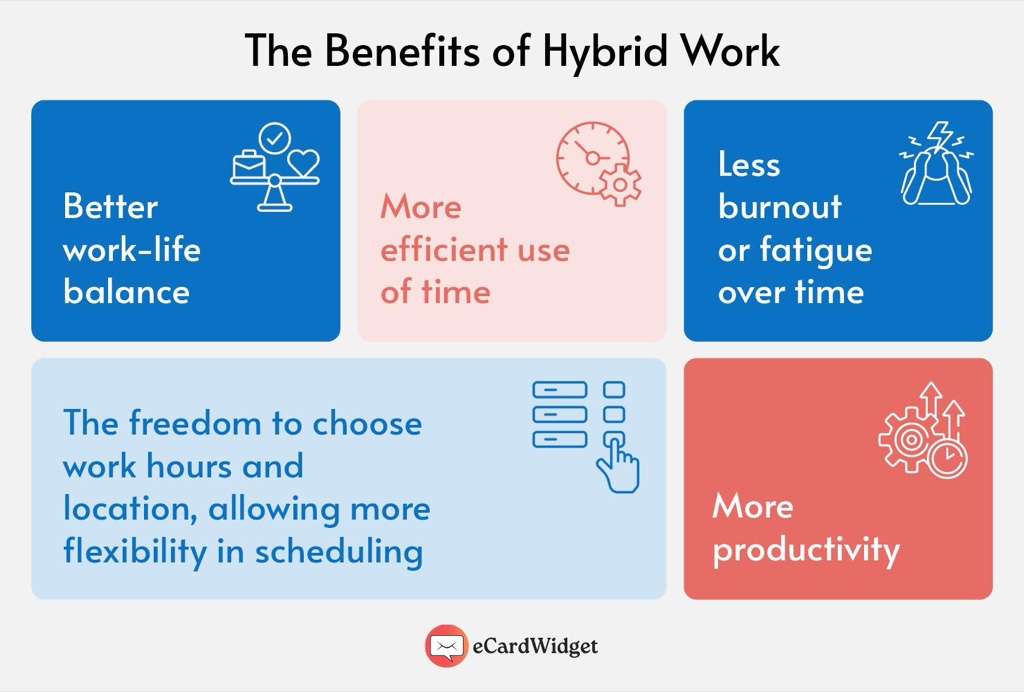
- Better work-life balance
- More efficient use of time
- Greater flexibility
- Less burnout or fatigue over time
- More productivity
By reducing commute time and providing more convenience to employees, companies can improve job satisfaction, promote well-being, and minimize burnout. Giving your employees more freedom to work in their preferred conditions and environment helps them stay motivated to exceed expectations and generate meaningful results every day.
What are the drawbacks of hybrid work?
Despite its many benefits, some companies are still reluctant to shift to a hybrid work model. Their main concerns include:
- Productivity. When employees spend less time in the office, there are fewer opportunities for traditional supervision and collaboration. Gallup reports that 54% of managers who supervise remote workers strongly agree that they trust their teams to be productive while working remotely, and 48% of hybrid workers say their team has not discussed a plan for collaborating effectively in a hybrid environment.
- Employee isolation. Employees may feel more isolated and disconnected from their team members when working from home. At-home work environments reduce the opportunity for spontaneous conversation with colleagues and passing compliments from managers, which can leave employees feeling unseen and unappreciated.
- Security. With employees accessing company data across various networks and from different locations, cybersecurity becomes a greater concern. Companies with remote policies need to invest in more training and set up protocols for secure information sharing between team members.
Fortunately, there are many tools and best practices you can use to overcome these drawbacks. With a thoughtful approach, you’ll be able to develop hybrid policies that help your employees reach their highest potential in their roles.
Why is it important to have a retention strategy for hybrid workers?
It’s important to create a retention strategy tailored to hybrid workers because the flexibility that attracts them can also make it easier for them to leave. Without daily in-person interactions, employees can quickly feel disconnected from your company’s culture and long-term vision. A deliberate retention plan helps address these challenges:
- Mitigating proximity bias. Hybrid workers might worry that spending fewer days in the office means fewer opportunities for recognition or career advancement compared to their on-site peers. Create opportunities for employees to connect directly with their managers and executive leadership to increase their visibility.
- Maintaining engagement. Because hybrid models can lead to feelings of isolation, proactive retention efforts, such as regular one-on-ones, inclusive team-building activities, and transparent communication, help build a unified culture regardless of physical location.
- Remaining competitive. Top talent values flexibility, and the market for remote-capable roles is competitive. If your hybrid experience is poorly managed or unsupported, employees can easily move to competitors offering more supportive hybrid environments.
By investing in the needs of your hybrid workforce, you not only reduce costly turnover but also build a dedicated, high-performing team. A clear retention strategy shows employees that you value their contributions and are committed to their long-term success, no matter where they log in from each day.
How to Create a Hybrid Employee Retention Plan
Building a workplace that supports both in-office and remote staff takes more than allowing flexible schedules. To build an effective hybrid employee retention strategy, design policies that build engagement, productivity, and loyalty on purpose. Follow these steps to build a plan that keeps your top talent committed to your organization.
1. Assess your current hybrid landscape
Before creating new policies or buying new software, you need a baseline understanding of how your team works today. Evaluating your existing hybrid environment can reveal blind spots and show you where to improve.
To evaluate your current employee landscape:
- Conduct a communications audit. Analyze where information bottlenecks occur between your on-site and remote staff. Track response times, project turnaround times, and activity in shared channels to see where and how your employees communicate.
- Review space and schedule utilization. Look at login data and office attendance records to see when and where people are actually working. This tells you whether your current hybrid policy matches your employees’ real habits.
- Host manager focus groups. Middle managers often carry the weight of hybrid communication challenges. Run small, confidential focus groups with them to pinpoint their biggest hurdles in managing distributed teams fairly.
2. Determine what employees need to succeed
Once you understand your baseline, uncover the tools, workflows, and support systems your hybrid team needs to close the gap between current frustrations and the way they want to work. Because no two home setups or working styles are identical, this should be an ongoing conversation.
Determine your hybrid workers’ needs by:
- Identifying onboarding and training gaps. Compare the ramp-up time and first-year retention of recent hybrid hires with your historical in-office data. Use what you find to improve distributed training with digital resource libraries, peer buddies, and virtual shadowing sessions, so new hires can succeed without in-person oversight.
- Conducting virtual workspace reviews. Rather than guessing what hardware to supply, have an HR specialist walk employees through a checklist of their home office setups. Once you know the gaps, offer an annual remote-work stipend so people can invest in what they need, whether that means faster internet, ergonomic seating, or a desk at a local coworking space.
- Moving to asynchronous knowledge sharing. Look at how information is stored and shared across your organization. Instead of relying on desk-side conversations or live meetings to relay project details, set up a central knowledge base. Ask teams to document processes, log decisions, and record video updates so off-site workers have the context they need to work independently.
3. Formalize your hybrid policies and programs
With a clear picture of your team’s baseline and needs, put your approach in writing. Unspoken hybrid rules and informal agreements lead to confusion, inequity, and eventually turnover.
Use these strategies to formalize your hybrid policy:
- Document core working hours. Set specific windows when all employees, regardless of location, are expected to be online for live collaboration. Define the remaining hours as flexible time so employees know exactly when they need to be available.
- Establish clear in-office expectations. Define how often hybrid employees need to be on-site. Whether you require specific days for departmental collaboration or a set number of days per month, write it down so employees can plan their lives and commutes.
- Standardize performance and promotion pathways. Create clear, written criteria for how performance is measured, evaluated, and rewarded. Spell out how off-site workers can gain leadership visibility and earn promotions so proximity bias doesn’t decide who advances.
4. Launch and iterate on your plan
A hybrid retention plan isn’t a set-it-and-forget-it document. Distributed work keeps changing, so introduce your plan thoughtfully and adjust it based on feedback and business needs.
Launch and refine your strategy by:
- Hosting a company-wide rollout meeting. Introduce the finalized policies in a dedicated town hall. Walk your team through the data behind your decisions, explain how the new programs work, and give a clear timeline for when changes take effect.
- Running a 90-day pilot period. Treat the launch as a test. Encourage managers and team members to try the new communication guidelines, software, and office schedules, and adjust anything that isn’t doing its job.
- Scheduling quarterly pulse surveys. Send short, targeted surveys to measure how your hybrid environment is working. Track engagement metrics and use the feedback to update your policies before small frustrations turn into retention problems.
6 Hybrid Retention Support Strategies for a Thriving Workplace
A hybrid work model can be a game-changer for employee engagement and retention, and it reduces the costs of hiring and onboarding new team members. Include the following strategies in your hybrid retention plan to improve your employees’ experience and encourage long-term professional growth.
1. Improve the hybrid onboarding experience.
Your hybrid employees’ onboarding experience sets the tone for the rest of their time with your company, so create a process that gives them everything they need to get up and running both in the office and at home.
Consider incorporating the following ideas into your onboarding experience:
- Make new employees feel at home by sending them personalized welcome eCards on their first day.
- Introduce them to the rest of the team during an in-person or virtual meeting.
- Supply the equipment they’ll need to work from home, such as a desk, monitor, and office chair.
- Share an onboarding packet with key details, such as communication guidelines and work schedule expectations.
- Schedule frequent check-ins so they have chances to ask questions.
Build loyalty from the start by showing hybrid employees that you’re invested in their long-term success. Since they won’t always be in the office with their team, help them start strong by building connections early and giving them the resources they need.
2. Invest in essential technology.
IT problems in remote or hybrid environments can quickly become a major issue. Equip your hybrid employees with user-friendly technology so they can spend their time on their work rather than troubleshooting.
Some time-saving and results-boosting tools for remote working include:

- Project management tools. Keep hybrid teams productive with tools such as Zoho, a cloud software suite for businesses, and Trello, a team collaboration platform. Tools like these help employees manage their workflow both in the office and at home.
- Messaging tools. Messaging apps like Slack and Microsoft Teams make it easy to update team members on tasks and ask questions in real time.
- Video conferencing tools. Video tools such as Zoom let employees meet face-to-face even when they aren’t in the same place. This cuts the time spent explaining complicated information and reduces miscommunication.
- Document and file sharing tools. Hybrid employees need access to shared files to get meaningful work done. Use tools with file transfer features and access settings, like Google Drive.
- Remote work supplies. From headsets to monitors, hybrid employees need physical tools to work remotely. Help them set up home offices where they can work as effectively as they do in the office.
To get the most from these investments, set up a clear IT support process for your off-site workforce, such as a virtual helpdesk, and pair it with software training during onboarding so everyone is comfortable with your tools from day one. Add software to engage employees alongside your productivity stack so recognition happens in the same places people already work.
Audit your tools regularly to remove redundant apps and keep your platforms connected. This prevents app fatigue and keeps your team focused on high-impact work instead of jumping between disconnected systems.
3. Be strategic about in-office days.
There are various ways to decide when hybrid employees work from home and when they come into the office. The right structure balances convenience and connection, which contributes to overall satisfaction and hybrid employee retention.
Since preferences vary from company to company, ask your employees about their ideal schedule and use their answers to choose your work model.
One way to maximize productivity, for instance, is to designate specific days of the week for different teams to come into the office. That way, hybrid employees know their teammates will be there and available to collaborate in person.
4. Promote culture and connection.
One of the biggest challenges hybrid employees face is fewer chances to build relationships with their colleagues. According to the Achievers Workforce Institute’s 2026 Engagement and Retention Report, recognition and connection are the most reliable retention drivers, yet only one in four employees say they feel appreciated or engaged at work.
When your employees are separated by location, it’s even more important to build a strong sense of company culture across your teams. Keep employees engaged by encouraging collaboration and hosting intentional events, both virtual and on-site, that help them build positive relationships.
Another way to strengthen connections between hybrid employees is to develop a system for peer-to-peer recognition. Through eCards, digital platforms, or an in-office wall of fame, make it easy for your staff to acknowledge one another for going above and beyond. Each hybrid employee then feels valued by their colleagues, which makes them more invested in your company’s long-term success.
5. Recognize your hybrid employees.
Beyond ad hoc peer-to-peer recognition, build official methods for recognizing employees into your hybrid employee retention plan. eCards are a convenient and memorable way to show your employees how much they matter, and you can send them for all kinds of occasions, from outstanding performance to birthdays to Administrative Professionals Day.
eCard software like eCardWidget lets you add your company’s logo and colors to eye-catching designs to show appreciation for your employees. You can start from pre-made templates or upload your own images.
For example, Modivcare, a healthcare company, uses its eCards to appreciate employees and reinforce its company values. Using the eCardWidget platform, Modivcare’s leadership created a set of branded eCard designs that represent each of its core values. Whenever an employee upholds one of these values, their manager or peers can send them the matching recognition eCard with a personal message.

Other popular options for recognizing your hybrid employees include:
Some employees prefer public acknowledgment of their accomplishments, while others would rather be recognized privately. Keep individual preferences in mind to get the most out of your appreciation efforts.

6. Collect feedback from hybrid employees.
Keep improving your hybrid employee retention efforts by collecting feedback from your employees. Send out regular surveys to gauge how well your work model and engagement efforts are working.
Some common questions to include in these surveys are:
- What is your ideal balance between in-office and remote work?
- Do you have the virtual and physical tools to carry out your work effectively?
- How connected do you feel with your fellow team members?
- How would you describe your productivity in the office versus working remotely?
- Are there any improvements you would like to see in our hybrid working arrangements?
Alongside employee feedback, track metrics such as your hybrid employee retention rate and office space use. If you’re just starting with a new work model, review these numbers monthly and adjust as you go.
Mastering Hybrid Employee Retention at Your Company
Companies adopting a hybrid work model can get the most from it, and ease concerns about productivity and retention, by building a fulfilling work experience for their employees.
Set your hybrid employees up for success with the structure and tools to be productive. Then, help them keep a healthy work-life balance so they return to work each day refreshed and ready to drive results.
To learn more about how your company can retain its top talent, explore these additional resources:
- 10 Ways to Conquer Employee Recognition and Why It Matters. Revamp your recognition strategy with 10 impactful approaches to employee appreciation.
- 18 Best Corporate Gifting Companies To Impress Constituents. Corporate gifting companies can support recognition at your company. Explore the best options to consider.
- Workplace Culture: A Guide To Better Corporate Atmosphere. Discover how your company can create a workplace culture that builds passionate, loyal employees.
